




Is the Motorcycle Market Really Crashing in 2026? Here's What the Sales Data Actually Shows

Enter your custom HTML codes in this section ...
VERDICT: HALF-TRUE — The slump is real. The "crash" is not. Most numbers in the doom narrative are genuine — but they are US-only figures from late 2025 and recycled headlines from the 2024–25 industry crisis, presented as breaking 2026 news. The narrative omits every recovery since: KTM was rescued, Energica was revived, Indian Motorcycle found a buyer, and Harley-Davidson's retail sales grew 8% in Q1 2026. What is actually happening is a painful restructuring of the heavyweight cruiser/touring segment while small-displacement bikes boom — a bifurcation, not a collapse.
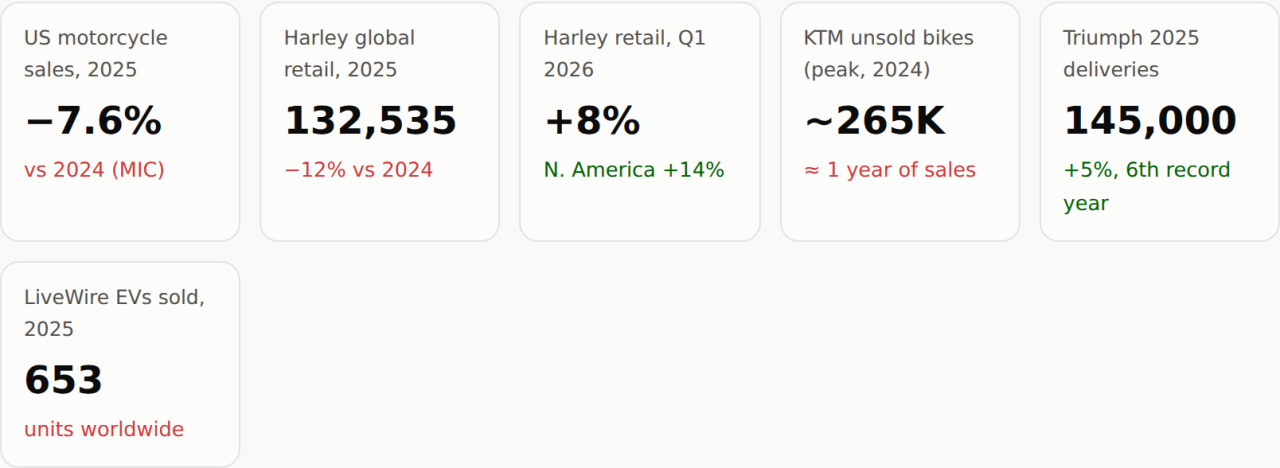
The numbers at a glance
The doom narrative, in one paragraph
If you've spent any time in motorcycle YouTube lately, you know the script. A dozen manufacturers, counted down like a funeral procession: Energica bankrupt; Suzuki down 13.7%; BMW down 10.8%; Honda down 8% and "dethroned" by Kawasaki, its dealer floors "chaotic" with leftover pandemic-era small bikes; LiveWire and Zero burning cash; Ducati and Triumph "squeezed"; CFMoto killed by tariffs; Polaris dumping Indian; KTM insolvent with 260,000 unsold bikes; and Harley-Davidson down 22% with loan delinquencies "skyrocketing."
It is worth knowing the genre before taking any of it at face value: the same faceless channels published near-identical "CRASH of 2025" videos a year earlier, and will publish "CRASH of 2027" next year. This is algorithm-optimized doom content. That doesn't automatically make it wrong — so let's check every claim against official data.
Claim 1: The sales percentages — mostly real, but US-only and cherry-picked
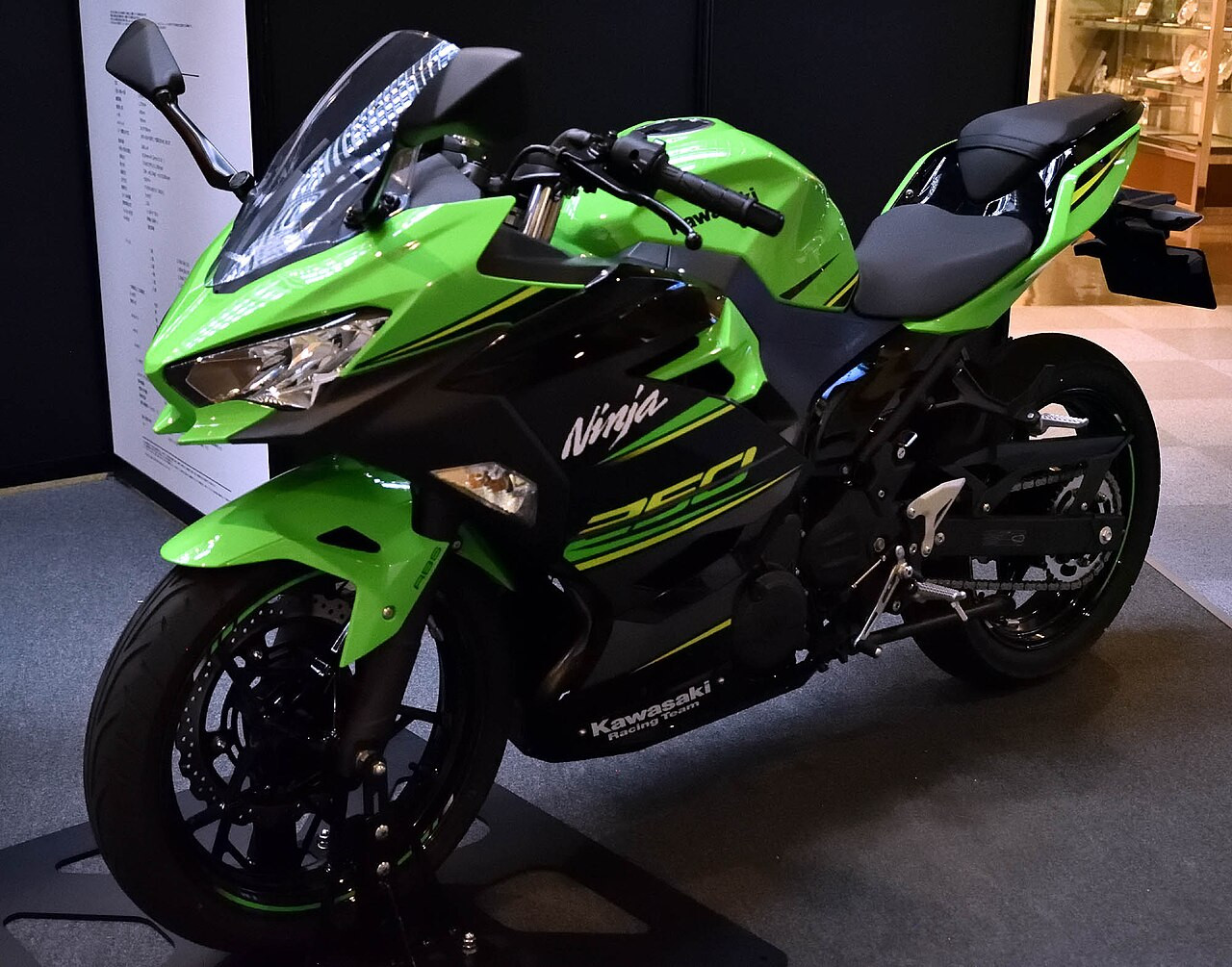
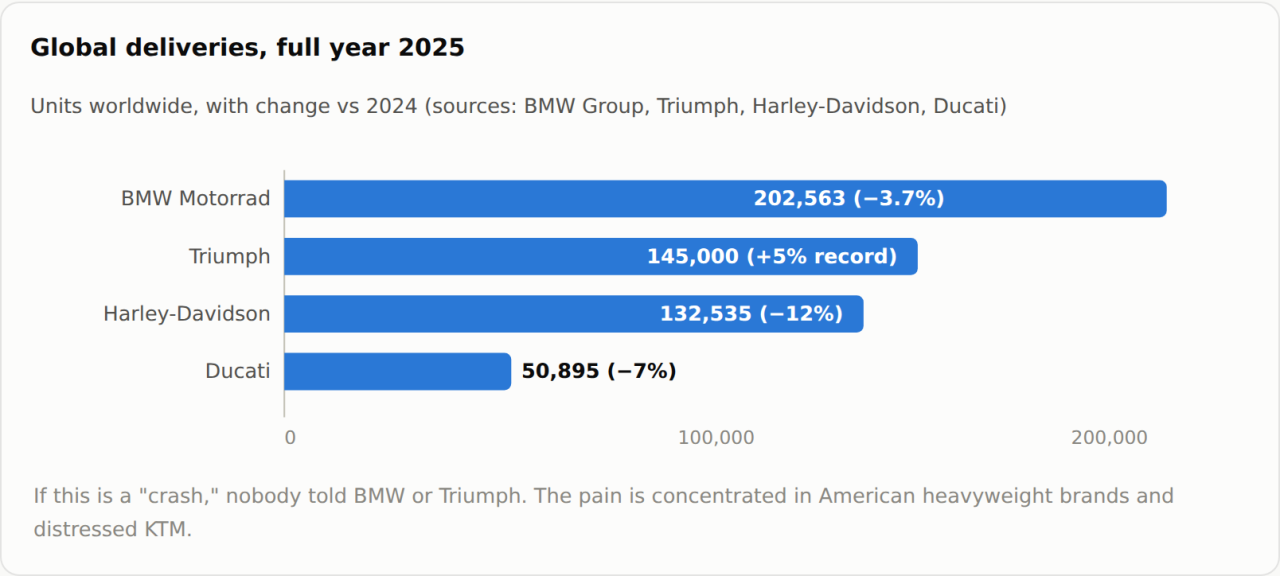
Almost every percentage in the doom narrative traces back to one dataset: US year-to-date brand sales through September 2025, as reported by MotorCyclesData. Suzuki −13.7%, BMW −10.8%, Honda −8%, KTM −23.8%, Kawasaki surging — the match is exact. So the numbers weren't invented. The trick is presenting US retail figures as a global collapse. Globally, BMW Motorrad delivered 202,563 bikes in 2025 — its fourth consecutive 200k+ year and still the premium-segment leader. Honda remains, by an enormous margin, the world's largest motorcycle maker. The "Honda dethroned by Kawasaki" claim is true only inside the United States.
Claim 2: "Harley is down 22% and delinquencies are skyrocketing" — cherry-picked and stale
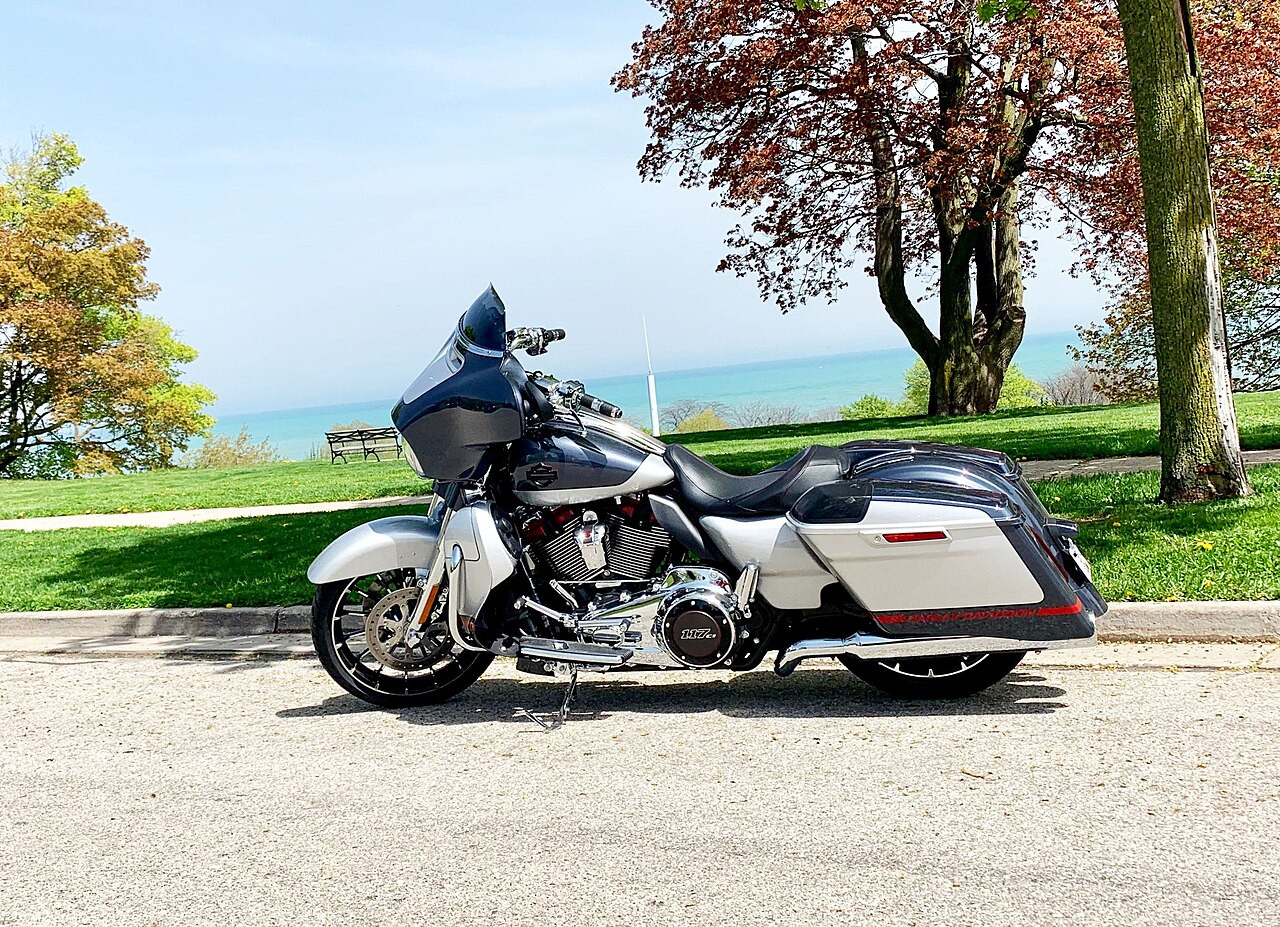
Harley-Davidson's worst quarter was Q1 2025, when retail sales fell 21% amid what the company called consumer uncertainty. The full year 2025 closed at −12% globally (132,535 bikes) with North America −13%. Painful — but then Q1 2026 retail sales rose 8% globally and 14% in North America, with dealer inventories down 22% year-over-year. The credit-stress claim has a real kernel: delinquencies did run at elevated levels through 2024–25 and S&P cut Harley's credit rating to junk in 2025. But Harley then sold roughly two-thirds of its loan book to KKR/PIMCO, and its Q1 2026 provision for credit losses fell to $13.2M from $53.3M a year earlier. "Skyrocketing," in mid-2026, is simply no longer true.
Claim 3: KTM's 260,000 unsold bikes — true, but the story ended 13 months ago
In late 2024 KTM entered court-supervised self-administration with reported unsold inventory of roughly 265,000 motorcycles — about a full year of sales — so the doom narrative's most dramatic number checks out. What it leaves out is everything since: Bajaj Auto injected some €800 million, creditors were paid their 30% quota on schedule, the restructuring formally concluded in 2025, and Bajaj took majority control. KTM is now a smaller, Indian-owned company working through discounted inventory — wounded, but not the unfolding catastrophe still being narrated in the present tense.
What the doomers get structurally right — and the chart that explains 2026
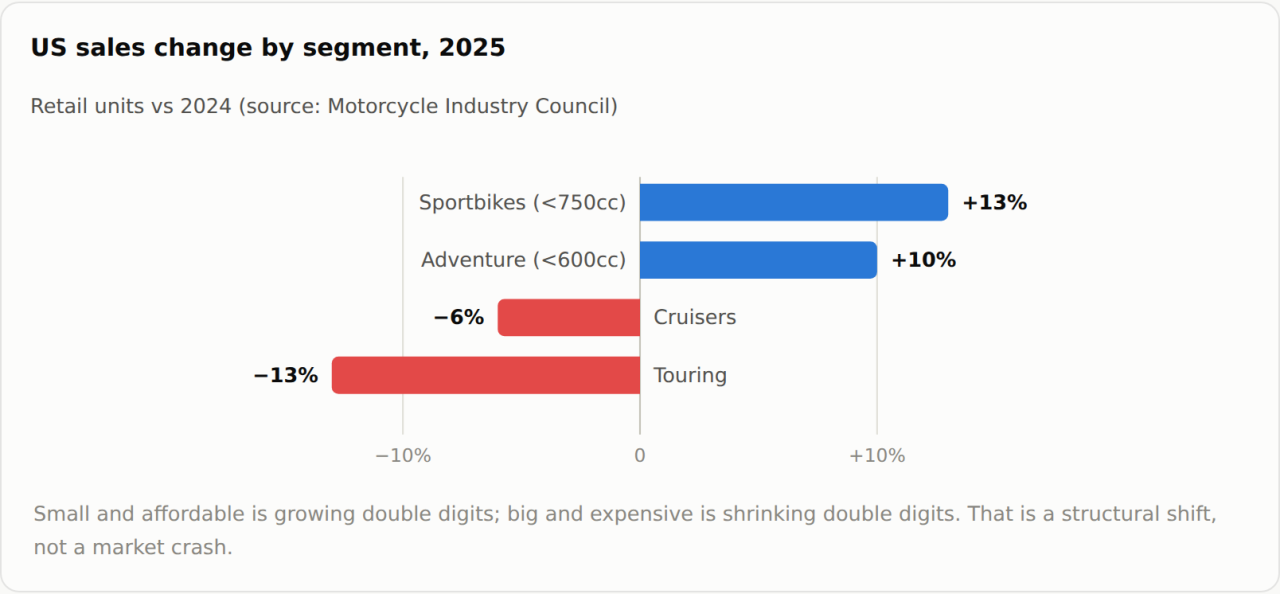
Underneath the doom framing, three things are correct. First, the traditional US market really is shrinking: −7.6% in 2025 per the Motorcycle Industry Council, on top of years of demographic erosion. Second, financing costs really did crush big-ticket bikes: at 8–9% APR, a $25,000 touring bike carries a car-sized payment. Third, the electric segment really is brutal: Energica went bankrupt in October 2024 (the doom videos omit its 2025 rescue by Singaporean investors), LiveWire sold just 653 bikes worldwide in 2025 against a guided $70–80M operating loss, and Zero needed a $120M raise to keep going.
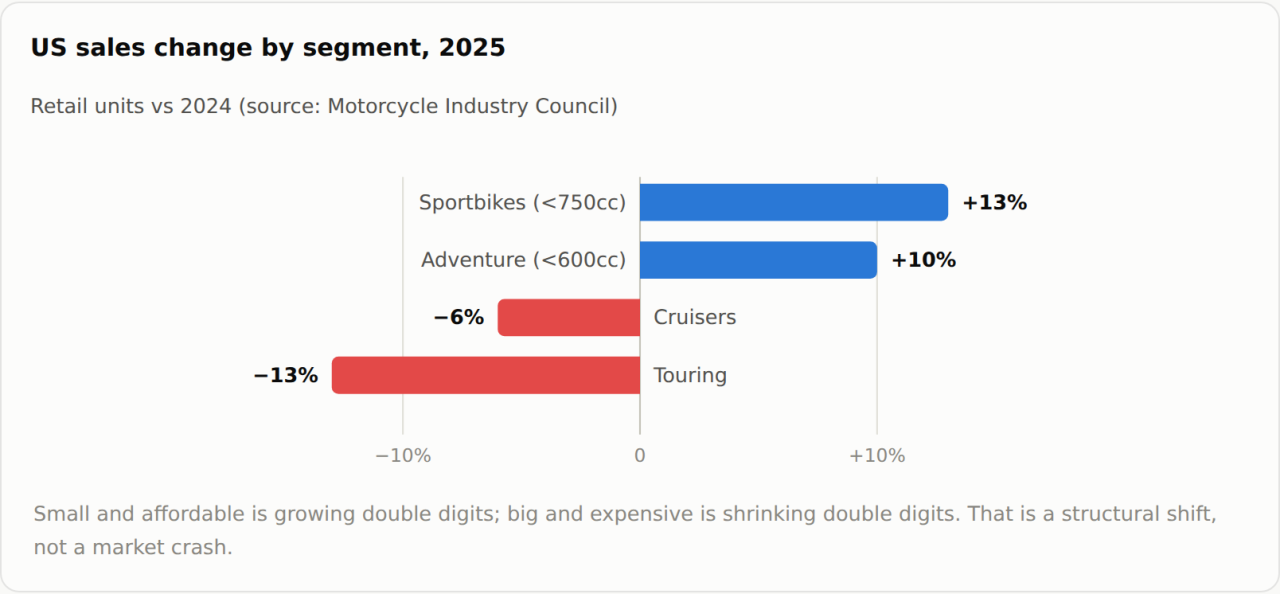
But the same MIC data shows why "crash" is the wrong word. Buyers didn't leave — they moved down-market:
The same split shows up across brands globally. The framing of Triumph as "squeezed" is the narrative's clearest error: Triumph posted its sixth consecutive record year in 2025 with 145,000 units (+5%), driven by exactly the affordable 400cc bikes the growing side of the market wants. Ducati slipped a manageable 7% to 50,895 units — and actually grew 4% in the US — while its parent explicitly cited Euro 5+ model changeovers, not collapsing demand.
The full scorecard: all 12 claims, traffic-light rated
🟢 TRUE — Honda lost the US No.1 spot to Kawasaki (US market only; Honda is still the world's biggest maker).
🟢 TRUE — LiveWire is burning cash: 653 bikes sold worldwide in 2025, $70–80M operating loss guided for 2026.
🟢 TRUE — IT HAPPENED — Polaris sold its majority stake in Indian Motorcycle to Carolwood LP, completed early 2026 (and Indian's US sales were up 4.9%).
🟠 TRUE BUT OUTDATED — Energica did go bankrupt (Oct 2024) — but was rescued in 2025 and relaunched for 2026.
🟠 TRUE BUT OUTDATED — KTM did hit ~265,000 unsold bikes and enter self-administration — the €800M Bajaj rescue closed the case in 2025.
🟡 PARTLY TRUE — Suzuki −13.7% and BMW −10.8%: real US year-to-date figures presented as a global collapse (BMW sold 202,563 bikes globally, −3.7%).
🟡 PARTLY TRUE — Zero Motorcycles is struggling but raised $120M and keeps operating.
🟡 PARTLY TRUE — Ducati slipped 7% but stayed profitable and grew 4% in the US; Euro 5+ changeovers explain part of the dip.
🟡 PLAUSIBLE — Tariffs did erode CFMoto's US price advantage, though it keeps expanding its lineup.
🟡 CHERRY-PICKED — "Harley down 22%": the worst quarter was −21%, the full year −12%, and Q1 2026 turned positive (+8%). Credit stress was real but provisions have since fallen 75%.
🔴 FALSE — "Triumph is squeezed": sixth consecutive record year, 145,000 units, +5%.
My take: it's a restructuring, not a crash
Score it up: of twelve claims, roughly three are cleanly true, two are true but a year stale and already resolved, six are half-truths built on US-only or cherry-picked figures, and one — Triumph — is the opposite of the truth. That is exactly the profile of algorithmically generated doom content: real headlines, blended without dates, context, or corrections, under a title engineered for fear.
The honest picture of mid-2026 looks like this. The legacy American heavyweight market is structurally shrinking — aging riders, $25k price tags and 8–9% financing did real damage, and 2025 was a genuinely bad year (US −7.6%, Harley −12%, an insolvent KTM, a junk-rated Harley balance sheet). But a crash implies collapsing demand everywhere, and the data shows the opposite on the growing side: sub-750cc sportbikes +13%, small adventure bikes +10% (up 52% since 2019), Kawasaki +14%, Triumph and its 400cc platform at record volumes, and younger and more female riders entering on affordable bikes. Even the hardest-hit player, Harley-Davidson, opened 2026 with retail growth and much leaner dealer inventories. The industry isn't dying; it is being repriced and handed to a different customer.
If you're shopping, the practical read: it's a buyer's market for big used cruisers and clearance KTMs, while the hot small-displacement segment holds value. If you're watching the industry, ignore the annual "CRASH!" thumbnails — the same channels will publish "The Motorcycle Market CRASH of 2027" next year regardless of what the data says.
Sources
- Powersports Business — MIC reports 2025 retail sales decline as buyers shift to smaller models
- RevZilla Common Tread — US motorcycle sales dropped 7.6% in 2025
- Powersports Business — Kawasaki surges to No.1 in the US market
- Harley-Davidson — Q4 & full-year 2025 results and 2026 outlook
- Harley-Davidson — Q1 2026 financial results (retail +8%, NA +14%)
- Investing.com — Harley-Davidson Q1 2025: sales skid 21%
- BMW Group — BMW Motorrad 2025: 202,563 motorcycles sold
- MotorCyclesData — Triumph 2025: 145,000 units, sixth record year
- Motorcycle.com — Ducati 2025 sales results (50,895 units)
- Jalopnik — KTM has 265,000 unsold bikes
- Powersports Business — Bajaj comes to KTM's rescue
- New Atlas — Bajaj takes majority ownership of KTM
- Electrek — Energica files for bankruptcy (Oct 2024)
- Electrek — Energica returns after bankruptcy (2025)
- RideApart — LiveWire sold fewer than 1,000 motorcycles in 2025
- Tech Funding News — Zero Motorcycles raises $120M
- Polaris — completion of Indian Motorcycle separation and sale to Carolwood LP
- TopSpeed — Harley-Davidson's credit downgrade to junk status


Comments