


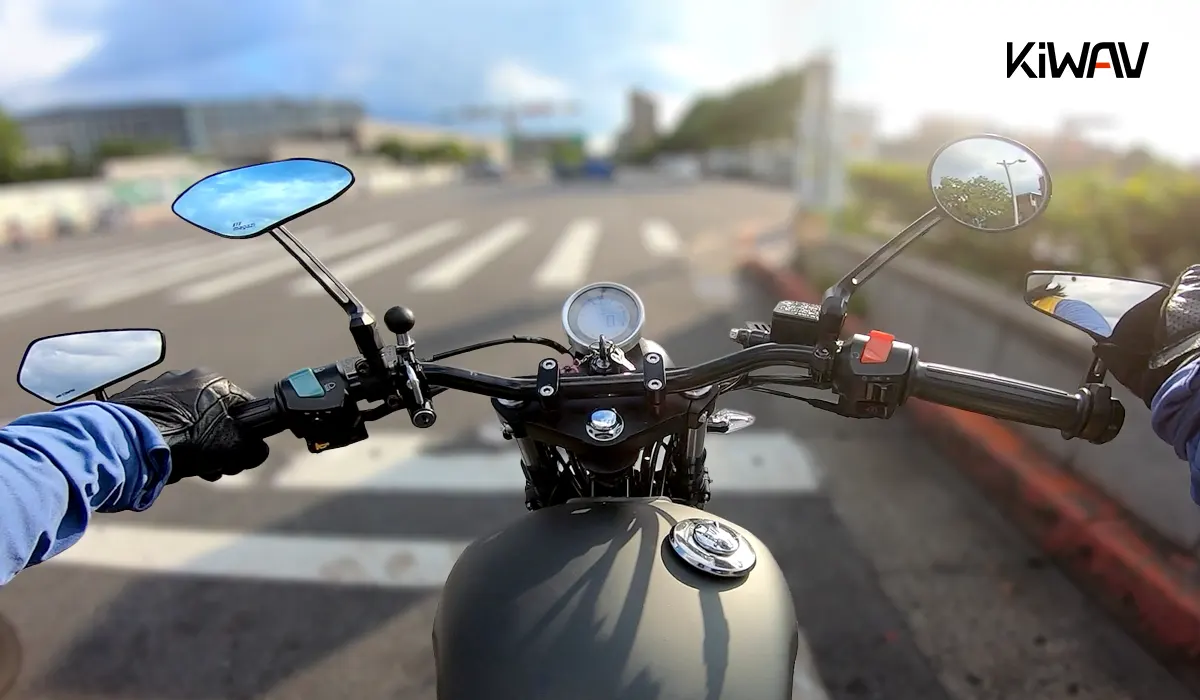
Motorcycle mirrors do more than satisfy legal requirements. They directly affect rear visibility, lane-change confidence, and overall riding awareness. Among the most common setups, riders often compare bar-end mirrors vs stock mirrors to decide which one gives a better view behind the bike.
The answer depends on mirror position, rider body shape, handlebar width, and riding style. In many cases, bar-end mirrors provide a wider and less obstructed rearward view, while stock mirrors offer a higher and more familiar factory-style position.
This guide explains the real differences between bar-end mirrors and stock mirrors, including visibility geometry, vibration, daily usability, and which setup may work better for different riders.
Why This Comparison Matters
Many riders assume mirrors are interchangeable as long as they reflect traffic behind. In practice, mirror placement changes what you actually see.
A poor mirror setup can cause:
- Shoulders or elbows blocking the view
- Narrow lane coverage
- Blurred reflections from vibration
- Delayed rear awareness during lane changes
That is why the comparison between stock motorcycle mirrors and bar-end mirrors is not just about style. It is about how effectively a rider can monitor surrounding traffic.
What Are Stock Mirrors?
Stock mirrors are the mirrors supplied by the motorcycle manufacturer. They are usually mounted:
- Near the brake and clutch perch
- On the fairing
- Above the handlebar line
Factory mirrors are designed to provide a basic legal rearward field of view across a broad range of riders. They are often practical and familiar, but they do not always give the best visibility for every body type or riding position.
Typical strengths of stock mirrors
- Familiar factory layout
- Higher viewing position
- Usually easy to fold or adjust
- Designed around OEM appearance and compliance
Common weaknesses of stock mirrors
- Shoulders often block part of the mirror
- Narrower spacing between left and right mirrors
- Some long mirror stems vibrate at speed
- May show too much of the rider’s arms instead of adjacent lanes
If your current mirrors mostly show your own shoulders, proper adjustment may help first→ How to Adjust Motorcycle Mirrors Properly
What Are Bar-End Mirrors?
Bar-end mirrors mount at the outer ends of the handlebars instead of near the control perch or fairing. This moves the mirrors farther outward from the rider’s body.
That wider placement is the main reason many riders choose them. By sitting farther apart, bar-end mirrors often create a broader rear visibility triangle and reduce body obstruction.
Typical strengths of bar-end mirrors
- Wider mirror spacing
- Less shoulder and elbow blockage
- Cleaner view of adjacent lanes
- Often more stable when paired with proper bar-end weights
- Sporty, minimal cockpit appearance
Common weaknesses of bar-end mirrors
- Lower mounting position than many stock mirrors
- May take time to get used to
- Can be less ideal in very tight filtering conditions
- Some universal designs are not equally stable or well engineered
If you want to see the range of designs this section describes — ultra-compact to full-size, chrome, black and real carbon fiber, with folding mechanisms and adjustable arms — you can browse KiWAV's bar-end mirrors, engineered and made in Taiwan.
Bar-End Mirrors vs Stock Mirrors: The Real Visibility Difference
The biggest difference is not just location. It is geometry.
Stock mirrors: narrower viewing triangle
Because stock mirrors sit closer to the centerline of the motorcycle, the left and right mirrors are spaced closer together. This can create:
- More overlap with the rider’s shoulders
- Reduced view of neighboring lanes
- More need to tuck elbows or shift posture
Bar-end mirrors: wider viewing triangle
Bar-end mirrors sit farther outboard, which increases horizontal mirror separation. This usually gives:
- Less body interference
- Better side-lane coverage
- Easier rear scanning without exaggerated body movement
For many riders, especially on naked bikes, sport bikes, and some standard motorcycles, this wider spacing is the main reason bar-end mirrors feel more effective than stock mirrors.
Why Some Riders See Better with Bar-End Mirrors
Not every rider experiences mirrors the same way. Rear visibility is affected by:
- Shoulder width
- Arm position
- Riding posture
- Handlebar width
- Mirror head size and convexity
Riders with broader shoulders or a more forward-leaning position often find that stock mirrors show too much of their upper body. In those cases, bar-end mirrors can dramatically improve usable rear vision.
This is especially relevant for:
- Sport bike riders
- Short riders dealing with shoulder obstruction
- Riders using wider bars
- Riders who want clearer lane awareness in urban traffic
Riders with a lower eye line or compact riding position? You may want to know→ How to Set Up Motorcycle Mirrors for Short Riders
Vibration: Which Mirror Type Is More Stable?
Mirror clarity matters just as much as mirror angle. A mirror that technically shows the road behind but becomes blurry at speed is far less useful.
Stock mirrors and vibration
Stock mirrors vary widely by motorcycle. On some bikes, OEM mirrors are excellent. On others, long stems and mounting position can allow more visible vibration, especially:
- On single-cylinder engines
- At certain RPM ranges
- On bikes with minimal damping in the mirror assembly
Learn more about mirror vibration → Why Motorcycle Mirrors Vibrate → How to Fix Motorcycle Mirror Vibration
Bar-end mirrors and vibration
A good bar-end mirror can be very stable because it mounts directly at the bar end. When combined with proper bar-end weights, the assembly may reduce oscillation and improve image clarity.
This matches your own preference pattern as well: bar-end weights are often important for preventing excessive mirror vibration, especially on lightweight or higher-vibration setups.
Still, quality matters. Cheap bar-end mirrors can shake badly, distort easily, or loosen over time. Mirror design, clamp structure, and material quality make a major difference.
Mirror stability is not only about mounting location but also about design quality → Why High-Quality Motorcycle Mirrors Matter
Which Setup Is Better for Lane Changes?
If the question is purely about rearward lane awareness, bar-end mirrors often have the advantage.
Why?
Because they usually:
- Show less of the rider’s shoulders
- Cover more of the neighboring lane
- Require less body repositioning to confirm traffic
That does not mean stock mirrors are unsafe. A well-designed OEM mirror setup can work very well. But when riders complain that they “cannot see past their shoulders,” bar-end mirrors are often the more effective solution.
Daily Riding Differences
Stock mirrors may suit you better if:
- You prefer a factory look
- You want the mirror higher in your line of sight
- You ride in extremely tight spaces often
- Your OEM mirrors already provide a clear, stable view
Bar-end mirrors may suit you better if:
- Your shoulders block stock mirrors
- You want a wider field of rear awareness
- You prefer a cleaner cockpit
- You ride a naked, sport, retro, or cafe-style motorcycle
- You want a more performance-oriented mirror position
When a mirror just feels right: The features riders notice over Time → Why Some Mirrors Feel Better in Daily Riding
Style vs Function: Is It Only About Looks?
No. Although bar-end mirrors are often chosen for style, the best reason to use them is functional visibility improvement.
Many riders first notice them because they look cleaner or more premium. But the long-term value usually comes from:
- Better rear coverage
- Reduced body obstruction
- Improved lane-check confidence
- More stable image on the right setup
That is why bar-end mirrors are not just a visual modification. On the right motorcycle, they can be a meaningful safety and awareness upgrade.
Quick Comparison: Bar-End Mirrors vs Stock Mirrors
| Feature | Stock Mirrors | Bar-End Mirrors |
|---|---|---|
| Mounting position | Perch, fairing, or upper handlebar area | Outer handlebar ends |
| Mirror spacing | Narrower | Wider |
| Shoulder obstruction | More common | Less common |
| Adjacent lane visibility | Moderate | Often better |
| Viewing height | Usually higher | Usually lower |
| Vibration control | Depends on OEM design | Often good with proper weights |
| Learning curve | Minimal | May take short adjustment period |
| Styling | Factory/OEM | Minimalist/custom/performance |
Which One Is Better Overall?
For many riders, bar-end mirrors provide better usable rear visibility than stock mirrors, mainly because the wider position reduces shoulder blockage and improves lane coverage.
However, stock mirrors still make sense when a rider wants:
- Factory ergonomics
- A higher mirror position
- Simple OEM replacement
- Proven compatibility with their bike
The better setup is the one that gives you a clear, stable, and low-obstruction rear view in your normal riding posture.
If your current stock mirrors mostly show elbows, shoulders, or blurred reflections, switching to a well-designed set of bar-end mirrors can be a major upgrade.
Bar-end models differ in mounting type, bar-size compatibility, and how much weight they carry to damp vibration, so the right set depends on the bike you ride. Our 2026 guide to the best bar-end mirrors by bike type compares current models and includes a fitment quick-reference table covering threaded, bolt-on, and clamp-on designs.
If the wider view is what you're after, the practical next step is checking fitment. KiWAV's bar-end mirror range covers clamp-on handlebars, threadless hollow bar ends, and bolt-in fitments from 5mm to 16mm across BMW, Triumph, Harley-Davidson, Indian, Royal Enfield, Moto Guzzi, Aprilia, Yamaha and Honda.
Frequently Asked Questions
Q: Are bar-end mirrors better than stock mirrors?
Bar-end mirrors are often better for rear visibility because they sit farther outward on the handlebars, reducing shoulder obstruction and widening the rear field of view. Stock mirrors can still work well, especially if they are properly designed and adjusted, but many riders find bar-end mirrors easier to use for lane awareness.
Q: Do bar-end mirrors give a wider view?
Yes, bar-end mirrors often give a wider usable view because the mirrors are spaced farther apart than stock mirrors. This wider positioning can improve visibility of adjacent lanes and reduce how much of the rider's shoulders appear in the mirror.
Q: Do stock motorcycle mirrors block rear visibility?
Stock mirrors can block rear visibility for some riders, especially if their shoulders, elbows, or riding posture interfere with the mirror view. This is a common reason riders switch to bar-end mirrors.
Q: Do bar-end mirrors vibrate less than stock mirrors?
They can. A well-designed bar-end mirror, especially when paired with proper bar-end weights, may produce a more stable image than some stock mirrors. However, vibration depends heavily on the quality of the mirror, the bike, and the mounting design.
Q: Who should choose bar-end mirrors?
Bar-end mirrors are often a good choice for riders whose stock mirrors show too much shoulder or elbow, riders who want a wider rearward view, and riders who prefer a minimalist or sport-oriented cockpit setup.
Q: Are bar-end mirrors legal?
In most markets bar-end mirrors are legal as long as they meet the local mirror requirements — typically a minimum reflective surface area, a required number of mirrors, and in Europe type approval. Rules differ by country and sometimes by state, so check your local regulation before fitting. You can compare designs across KiWAV's bar-end mirror range, where each product page lists its specifications.
Q: Are bar-end mirrors any good for everyday riding?
For daily riding the main gains are a wider view and less shoulder blockage, which matters most in traffic and during lane changes. The trade-off is added handlebar width, so check clearance if you filter or park in tight spaces. Compact and folding designs in the bar-end mirror range are made for exactly this.
Q: Are motorcycle mirrors convex?
Many motorcycle mirrors are convex, which widens the field of view but makes vehicles appear farther away and smaller than they really are — this is why convex mirrors carry a warning that objects are closer than they appear. Flat mirrors show true distance but cover a narrower view. If glass type matters to you, check the specification on the individual product pages in the bar-end mirror range.
Q: Are motorcycle mirrors universal?
Not entirely. Handlebar mirrors depend on thread size and pitch, and bar-end mirrors depend on whether your bar end is threadless and hollow or takes a bolt — KiWAV alone lists fitments from a 5mm Triumph bolt up to a 16mm Yamaha bolt, plus clamp-on options for 7/8" and 1" bars. Confirm yours with the bar-end mirror fitment check, then pick from the bar-end mirror range.
Final Takeaway
When comparing bar-end mirrors vs stock mirrors, the core issue is not appearance. It is rear visibility geometry.
Stock mirrors are practical and familiar, but bar-end mirrors often create:
- Wider mirror spacing
- Less rider-body obstruction
- Stronger awareness of adjacent lanes
- A cleaner and more confidence-inspiring rear view
For riders who want improved rearward visibility, especially on naked and sport-oriented motorcycles, bar-end mirrors are often the more effective setup.
Ready to upgrade your rear view? Browse all KiWAV bar-end mirrors — or if you're not sure which mount your bike uses, start with the bar-end mirror fitment check first.
From here, you can explore: