


How Riders Monitor Traffic Behind Them
Rear awareness is one of the most important safety skills for motorcycle riders. Unlike cars, motorcycles provide limited rearward visibility and require riders to actively monitor traffic behind them. Good rear awareness helps riders detect approaching vehicles, anticipate lane changes, and respond to potential hazards earlier.
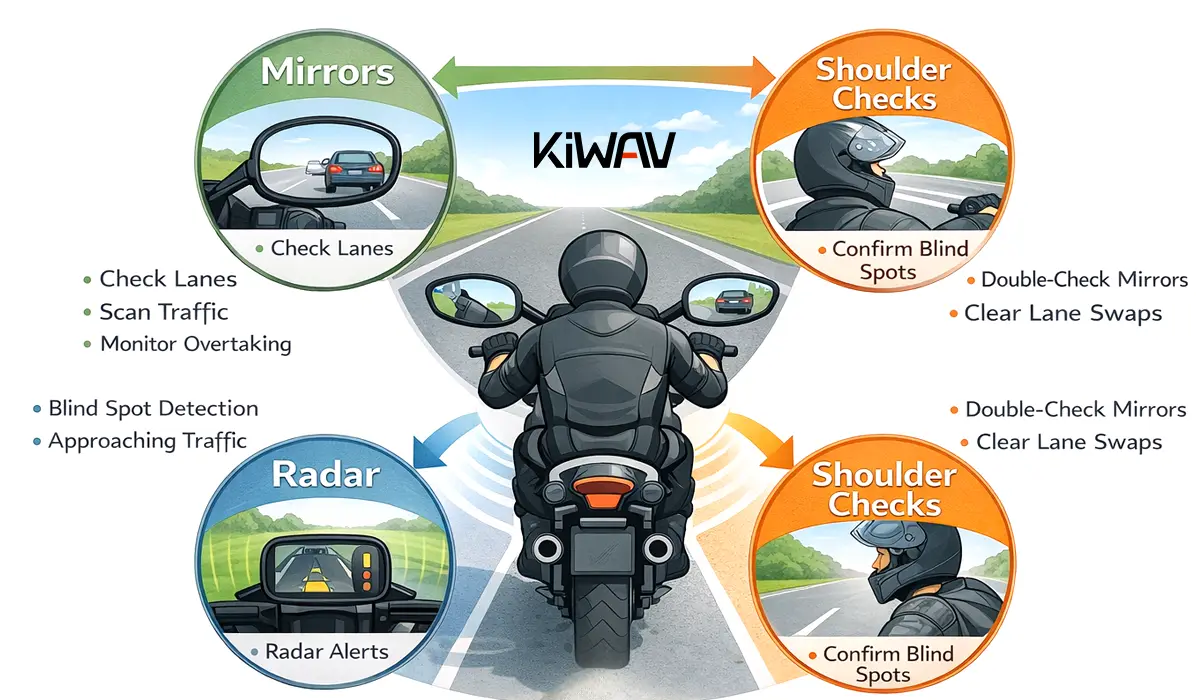
Modern riders use a combination of three main methods to maintain awareness behind their motorcycle:
- Rear-view mirrors
- Shoulder checks
- Electronic detection systems such as radar
Each method plays a different role, and experienced riders typically combine all three.
Why Rear Awareness Matters for Motorcycle Safety
Motorcycles are smaller and less visible than cars, which means riders must compensate with better situational awareness. Monitoring what is happening behind the motorcycle helps riders:
- Prepare for overtaking vehicles
- Avoid sudden lane conflicts
- Anticipate aggressive or distracted drivers
- Maintain safe positioning in traffic
Without rear awareness, a rider may not notice vehicles approaching quickly from behind or changing lanes unexpectedly.
Method 1: Motorcycle Mirrors
Rear-view mirrors are the primary tool riders use to monitor traffic behind them. Properly adjusted mirrors allow riders to scan traffic without turning their head away from the road ahead. Mirrors provide continuous visibility and are especially useful in situations such as:
- Highway riding
- Lane changes
- Stop-and-go traffic
- Monitoring vehicles approaching from behind
However, mirrors also have limitations. Because a rider’s body sits between the mirrors, some blind spots will always exist. For this reason, mirrors should be adjusted correctly to maximize the visible area behind the motorcycle.
→ Read: How to Adjust Motorcycle Mirrors Properly
Method 2: Shoulder Checks
A shoulder check is a quick glance over the rider’s shoulder to confirm that a lane is clear before changing position. Even with well-adjusted mirrors, shoulder checks remain an essential part of safe riding. They help riders verify areas that mirrors cannot fully show.
Typical situations where riders use shoulder checks include:
- Lane changes
- Merging onto highways
- Overtaking slower vehicles
- Moving around traffic obstacles
Experienced riders often perform a quick mirror check first, followed by a shoulder check before changing lanes.
Method 3: Radar and Blind-Spot Detection Systems
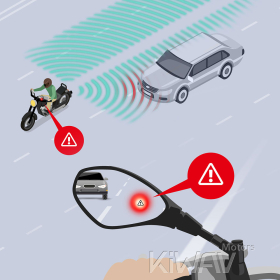
Modern technology has introduced a new category of rear-awareness tools: radar-based detection systems. These systems use sensors to monitor traffic approaching from behind and alert riders when a vehicle enters a potential blind spot.
Radar technology is already widely known in the cycling world through devices like the Garmin Varia radar, which warns riders when cars approach from behind.
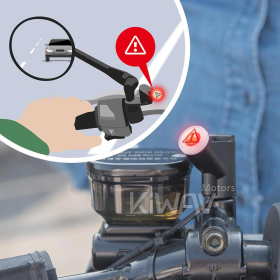
For motorcycles, similar concepts are now appearing in dedicated blind-spot detection systems. For example, the KiWAV BSDII blind spot detection system uses 79 GHz short-range radar designed specifically for motorcycle environments to detect vehicles approaching from the rear or from adjacent lanes.
Radar-based systems can provide:
- Visual alerts when vehicles approach from behind
- Blind-spot warnings during lane changes
- Additional situational awareness in traffic
Unlike mirrors, radar sensors can detect fast-approaching vehicles before they appear clearly in the mirror view, which can be helpful on highways or when riding in dense traffic.
However, radar should be viewed as a supporting safety technology, not a replacement for traditional visibility habits.
Experienced riders still rely on a combination of:
- Mirrors for constant rear monitoring
- Shoulder checks for confirming lane changes
- Radar alerts for early warning of approaching traffic
Used together, these systems create a multi-layered awareness strategy that helps riders maintain a clearer understanding of what is happening behind them.
→ Read: Garmin Radar vs Mirrors for Rear Visibility
How Experienced Riders Combine All Three Methods
Rather than relying on one system, experienced riders use a layered awareness approach.
Example scanning pattern:
- Quick mirror scan
- Identify approaching vehicles
- Perform shoulder check
- Change lane or position safely
Radar alerts can further assist by warning riders about vehicles approaching rapidly from behind. This multi-layer method helps riders maintain continuous awareness of surrounding traffic.
Common Rear Awareness Mistakes
everal common mistakes reduce a rider’s ability to monitor traffic behind them.
Mirrors adjusted too far inward
This causes mirrors to show mostly the rider’s shoulders rather than the road behind.
Relying only on mirrors
Mirrors cannot eliminate blind spots completely.
Shoulder checks remain essential before lane changes.
Ignoring approaching traffic from behind
Many riders focus only on vehicles ahead, but traffic approaching from behind can create dangerous situations, especially at highway speeds.
How Mirror Design Affects Rear Awareness
Not all mirrors provide the same field of view. Several design factors influence how well a rider can see behind the motorcycle.
Important factors include:
- Mirror position on the handlebars
- Mirror width and placement
- Convex vs flat mirror glass
- Mirror vibration at speed
For example, mirrors mounted farther outward—such as bar-end mirrors—often provide a wider rearward view because they sit outside the rider’s shoulders.
→ Read: Bar-End Mirrors vs Stock Mirrors: Which Gives Better Rear Visibility?
The Goal: Continuous Awareness Behind the Motorcycle
Effective rear awareness allows riders to build a mental picture of the traffic around them.
This includes knowing:
- Which vehicles are approaching from behind
- Which vehicles are in adjacent lanes
- How quickly traffic is closing distance
When riders maintain this awareness, they can make smoother and safer decisions on the road.
Key Takeaways & Related Guides
- Rear awareness is essential for motorcycle safety
- Mirrors provide continuous monitoring behind the bike
- Shoulder checks confirm blind-spot areas
- Radar systems add an additional detection layer
- Combining all three methods provides the best awareness
Maintaining awareness behind the motorcycle helps riders anticipate traffic movements and respond earlier to potential hazards.
From here, you can explore: