


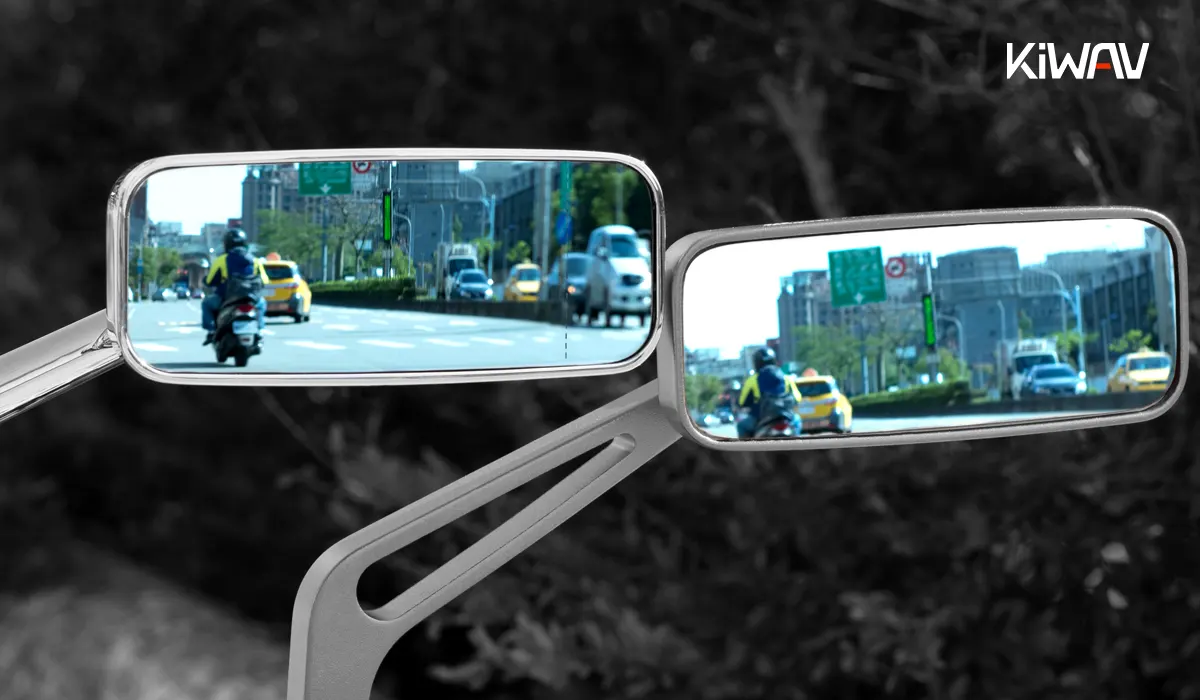
How Mirror Curvature Affects Motorcycle Rear Visibility
Motorcycle mirrors may look simple, but the shape of the mirror glass plays a major role in how much of the road a rider can see behind the motorcycle. Rear visibility, blind-spot coverage, and distance perception are all influenced by the curvature and optical design of the mirror surface.
Most riders think mirrors are simply “normal” or “wide-angle,” but the real difference lies in how the mirror glass is shaped.
Quick Answer
Wide-angle motorcycle mirrors use stronger convex curvature (often around 400R–800R) to expand the field of view, while standard mirrors use milder convex curvature (around 1000R or more) that provides more natural distance perception but a narrower viewing angle.
Understanding Mirror Types
In motorcycle mirror design, three mirror surface types are commonly discussed:
- Flat (plane) mirrors
- Convex mirrors
- Aspherical mirrors
Understanding these mirror types helps riders choose mirrors that provide the best balance between wide rear visibility and accurate distance perception.


Flat Mirrors (Plane Mirrors)
A flat mirror, also called a plane mirror, reflects images without distortion. Objects appear at their true size and true distance, making it easy to judge how far away a vehicle is.
However, flat mirrors reflect only a narrow field of view.
Because motorcycles rely entirely on side mirrors for rear visibility, a flat mirror would leave large blind spots behind the rider. For this reason, flat mirrors are rarely used on motorcycle side mirrors.
Most motorcycle mirrors instead use convex mirror glass to expand the visible area behind the bike.
Convex Mirrors
Convex mirrors have a slightly curved surface that bulges outward. This curvature allows the mirror to reflect light from a wider area behind the motorcycle.
Convex mirrors help riders see:
- More of the road behind
- Vehicles approaching from adjacent lanes
- Traffic approaching from wider angles
The trade-off is that objects appear smaller and slightly farther away than they actually are.
Riders usually adapt to this quickly, which is why convex mirrors are the standard mirror design used on most motorcycles today.
Standard Mirrors vs Wide-Angle Mirrors
Although most motorcycle mirrors are convex, the degree of curvature varies.
| Mirror Type | Optical Design | Typical Curvature |
|---|---|---|
| Standard mirrors | Mild convex glass | Around 1000R or more |
| Wide-angle mirrors | Stronger convex glass | Around 400R–800R |
Standard mirrors use gentle curvature, producing a natural-looking image that is easy to interpret.
Wide-angle mirrors use stronger curvature, which expands the visible area behind the motorcycle.
How Wide-Angle Mirrors Expand the Field of View
The main advantage of wide-angle mirrors is the expanded field of view.
Because the mirror surface curves more strongly, it reflects light from a wider angle. This allows riders to see vehicles that might otherwise fall outside the viewing area of a standard mirror.
Benefits include:
- Improved detection of vehicles approaching from behind
- Better awareness of adjacent traffic lanes
- Reduced blind-spot areas near the motorcycle
For riders navigating busy urban traffic or multi-lane highways, the wider viewing angle can significantly improve rear awareness.
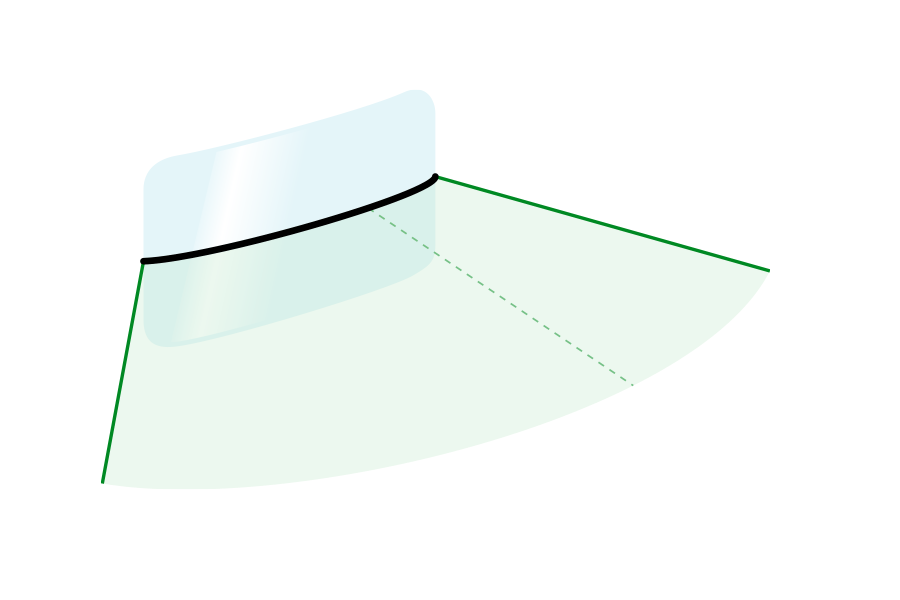
Diagram: Mirror Curvature vs Field of View
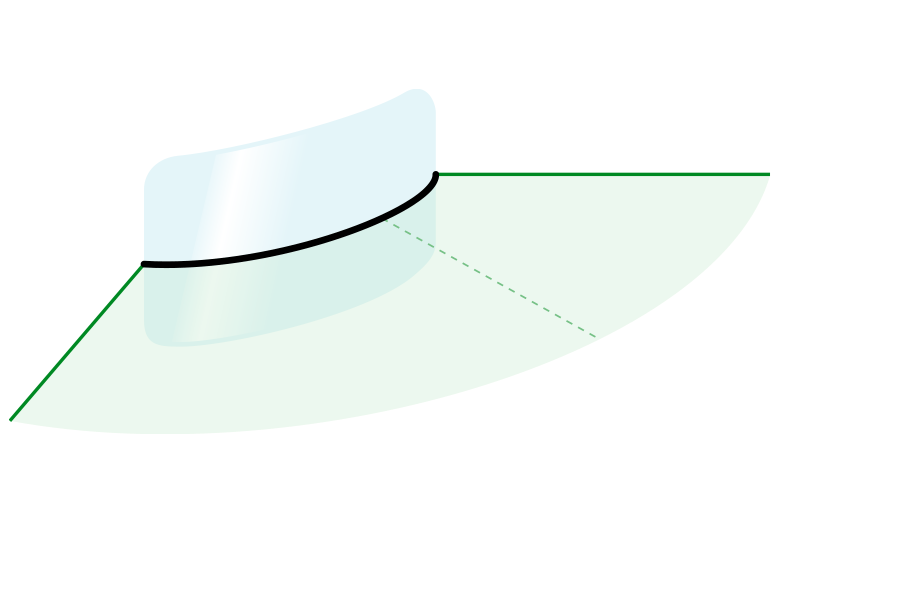
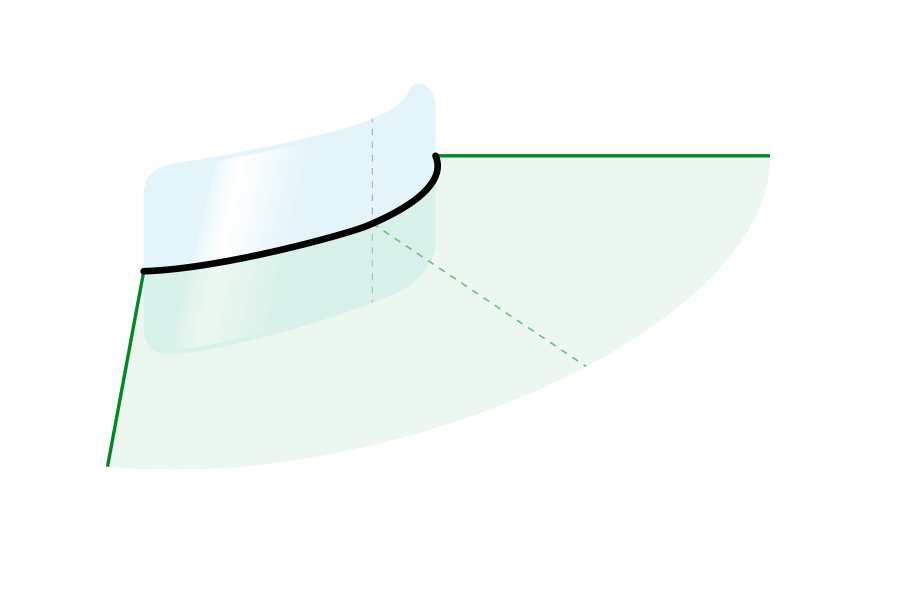
Mirror curvature affects field of view. Standard motorcycle mirrors are usually mildly convex, while wide-angle mirrors use stronger convex curvature to show more of the road behind. Aspherical mirrors combine both in one mirror.
The stronger the mirror curvature, the wider the viewing angle.
This diagram illustrates how mirror curvature affects visibility.
Standard mirror
(curvature: 1000R+)
Mild convex curvature, more natural distance perception.
Wide-angle mirror
(curvature: 400R–800R)
Stronger convex curvature, wider field of view.
Aspherical mirror
(curvature: combination)
Mild convex inner zone + stronger convex outer zone.
Why Small Mirrors Can Still Cover a Wide Area
Many compact motorcycle mirrors—especially small bar-end mirrors—use stronger convex glass with a curvature radius around 400R.
The “R” value refers to the radius of curvature of the mirror surface.
Smaller radius = stronger curvature = wider field of view.
| Mirror Curvature | Field of View |
|---|---|
| 1000R | Mild convex |
| 800R | Wider viewing |
| 400R | Very wide viewing |
Because 400R mirrors curve more strongly, they can reflect a much wider area behind the motorcycle, even when the mirror itself is relatively small.
This is why compact bar-end mirrors can still provide good rear visibility.
The Trade-Off of Stronger Convex Mirrors
The wider viewing angle comes with a compromise.
Because the mirror curvature is stronger:
- Objects appear smaller
- Vehicles may appear farther away than they actually are
For riders used to standard mirrors, this can feel unusual at first. Many riders report that it takes a short adjustment period to become comfortable judging distances with stronger convex mirrors.
Some riders appreciate the expanded visibility, while others prefer mirrors with milder curvature.
Aspherical Mirrors: A Hybrid Design
Aspherical mirrors use two different mirror curvatures within the same mirror surface.
Typical layout:
Inner mirror zone → mild convex for accurate distance perception
Outer mirror zone → stronger convex for wide-angle visibility
This design allows riders to maintain distance accuracy in the center of the mirror, while the outer portion expands the visible field.
Aspherical mirrors are widely used in modern automotive mirrors and are increasingly found in premium motorcycle mirrors.
Mirror Adjustment Matters More Than Mirror Type
Mirror curvature is important, but mirror adjustment often has a greater impact on rear visibility than mirror type.
Even a wide-angle mirror cannot provide good visibility if it is poorly positioned.
Proper mirror setup should ensure:
- Shoulders occupy only a small portion of the mirror
- Mirrors show adjacent lanes
- The rearward viewing area is maximized
See also: How to Adjust Motorcycle Mirrors Properly
Mirror Position Also Affects Visibility
Mirror curvature is only one factor affecting rear visibility. The mounting position of the mirror also plays a major role.
Mirrors mounted farther outward—such as bar-end mirrors—often provide a wider rear view because they sit outside the rider’s shoulders.
See also: Bar-End Mirrors vs Stock Mirrors
Wide-Angle Mirrors vs Standard Mirrors: Quick Comparison
| Feature | Wide-Angle Mirrors | Standard Mirrors |
|---|---|---|
| Field of view | Wider | Narrower |
| Blind-spot coverage | Better | More limited |
| Distance perception | Slight distortion | More accurate |
| Learning curve | Slight adjustment | Very natural |
Frequently Asked Questions
Q: Are motorcycle mirrors flat or convex?
Most motorcycle mirrors are convex rather than flat. Convex mirrors curve slightly outward, allowing riders to see a wider area behind the motorcycle. This wider field of view helps reduce blind spots and improves awareness of traffic approaching from adjacent lanes.
Q: What does 400R mean on a motorcycle mirror?
The “R” value refers to the radius of curvature of the mirror surface. A mirror labeled 400R has a stronger convex curvature than a mirror with a larger radius such as 1000R. Stronger curvature expands the field of view but makes objects appear smaller and slightly farther away.
Q: Are wide-angle motorcycle mirrors better?
Wide-angle mirrors can improve rear visibility because they cover a larger viewing area behind the motorcycle. This helps riders detect vehicles approaching from adjacent lanes or from farther behind. However, stronger convex mirrors may slightly distort distance perception, so some riders prefer standard mirrors with milder curvature.
Q: Why do small bar-end mirrors still provide good visibility?
Many compact bar-end mirrors use stronger convex glass (often around 400R). This stronger curvature expands the field of view, allowing the mirror to reflect a wider area even though the mirror surface itself is smaller.
Q: What is an aspherical motorcycle mirror?
An aspherical mirror combines two different mirror curvatures. The center of the mirror uses mild convex curvature for accurate distance perception, while the outer edge uses stronger curvature to expand the field of view. This design helps reduce blind spots while keeping the center image easier to interpret.
Key Takeaway
- Most motorcycle mirrors use convex glass rather than flat mirrors
- Standard mirrors use mild convex curvature for natural viewing
- Wide-angle mirrors use stronger curvature to expand the field of view
- 400R mirrors allow small mirrors to cover a wider viewing area
- Aspherical mirrors combine wide visibility with better distance perception
- Mirror adjustment and mounting position also affect rear visibility
Choosing between wide-angle mirrors and standard mirrors ultimately depends on riding conditions, mirror size, and rider preference.
From here, you can explore: